Renovation in France: The Complete Decision Guide
A decision pathway for permissions, protected sectors, contractor evidence, insurance, RGE status and aid boundaries.
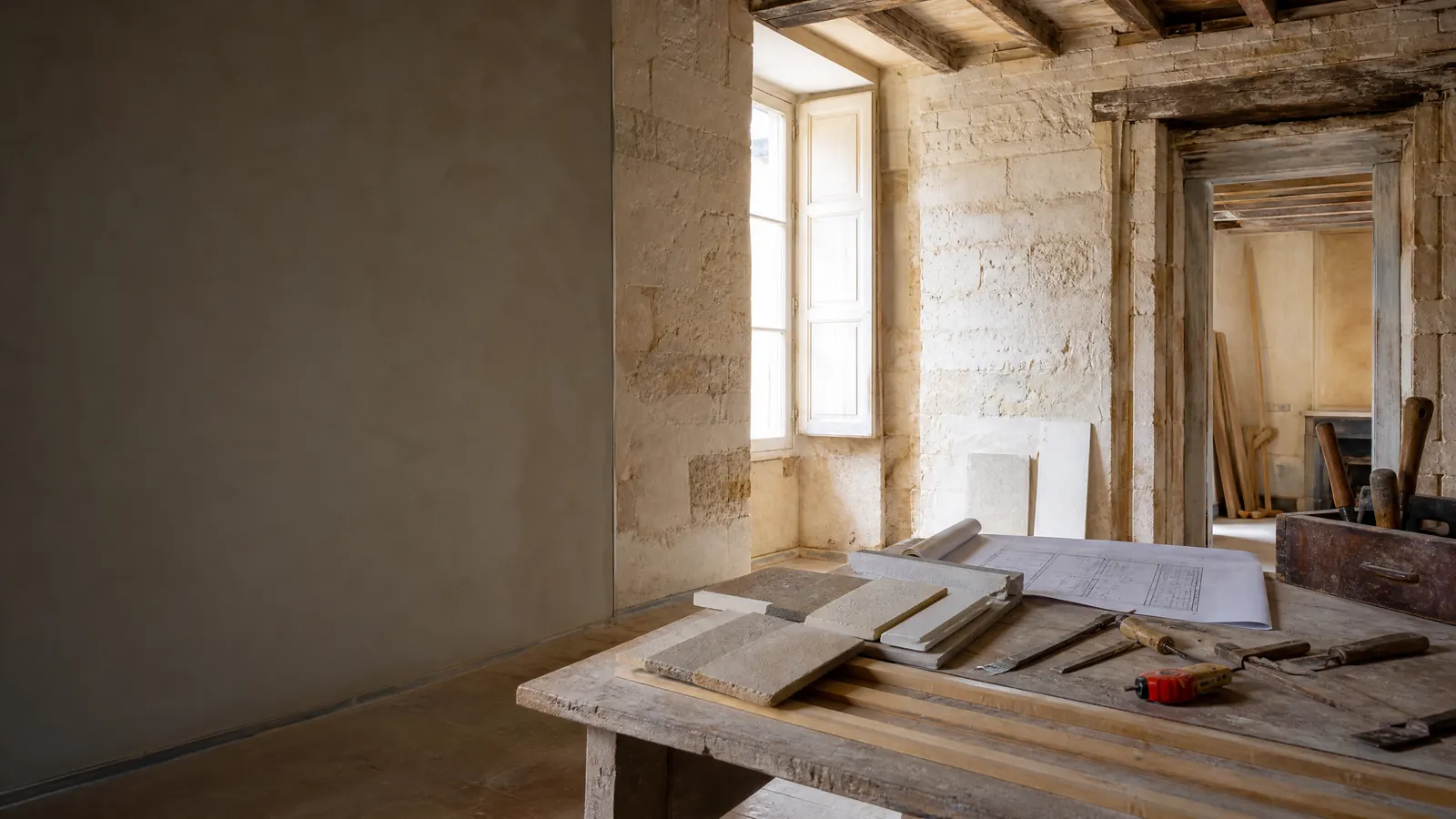
This flagship guide provides a clear, decision-focused pathway for planning and executing a property renovation in France. It covers planning permissions, protected sectors, contractor checks, insurance, RGE status, and France Rénov' aid boundaries, helping you navigate the complex regulatory landscape and avoid common pitfalls. Whether you are restoring a historic chateau or updating a modern apartment, this guide serves as your central hub for making informed, compliant decisions.
The Six-to-Eight-Step Decision Pathway
Successfully renovating a property in France requires a structured, methodical approach. The French administrative system is rigorous, and missteps can lead to significant delays, financial penalties, or even orders to demolish completed work. Follow these essential steps to ensure compliance and protect your investment:
1. Define the Scope and Check Protected Sectors Before you even begin to draft plans or contact builders, you must determine the exact location of your property in relation to heritage protections. France fiercely guards its architectural history. You must check if your property is classified as a historic monument, located near one, or situated within a protected sector such as a *Site Patrimonial Remarquable* (SPR).
If your property falls within a 500-meter radius of a historic monument and is visible from it (or visible at the same time as the monument), your project will be subject to the scrutiny of the *Architectes des Bâtiments de France* (ABF) [S1]. The ABF has the authority to dictate materials, colors, and architectural styles to ensure the new work harmonizes with the historic surroundings. Ignoring this step is a critical error; the ABF's approval is a prerequisite for any planning permission in these zones. You can verify your property's status by consulting the *Plan Local d'Urbanisme* (PLU) at your local *Mairie* (Town Hall) or checking with the *Direction Régionale des Affaires Culturelles* (DRAC).
2. Consult France Rénov' for Energy Upgrades France is aggressively pushing for improved energy efficiency in its housing stock. If your renovation includes insulation, heating system upgrades, or window replacements, you must engage with the state-sponsored service, France Rénov'.
For comprehensive energy renovations (known as *rénovation d'ampleur*), a personalized appointment with a France Rénov' advisor (*Mon Accompagnateur Rénov'*) is now a mandatory step before you can even submit an application for financial aid under the MaPrimeRénov' scheme [S2]. This advisor will help you define the most effective sequence of works, estimate costs, and calculate the exact financial assistance you are eligible to receive. Do not sign any quotes (*devis*) before this consultation, as doing so may invalidate your eligibility for state funding.
3. Determine the Required Planning Permission The scope of your renovation dictates the type of administrative authorization you must secure from your local *Mairie*. The two primary forms of permission are the *Déclaration Préalable de travaux* (DP) and the *Permis de Construire* (PC) [S3].
- Déclaration Préalable (DP): This is required for smaller projects. Generally, if you are creating between 5 and 20 square meters of new floor area (*surface de plancher*) or footprint (*emprise au sol*), a DP is sufficient. In urban zones covered by a PLU, this threshold is raised to 40 square meters, provided the total area of the building does not exceed 150 square meters after the extension. A DP is also mandatory for any changes to the exterior appearance of the building, such as installing new windows, changing the roof, or painting the facade [S9].
- Permis de Construire (PC): This is required for larger projects, such as creating more than 20 square meters of new floor area (or 40 square meters in a PLU zone), or if the total floor area of the property exceeds 150 square meters after the extension. If the 150-square-meter threshold is crossed, you are also legally obligated to use a registered architect to draw up the plans [S10]. Furthermore, changing the destination of a building (e.g., converting a barn into a dwelling) while modifying the facade or load-bearing structures always requires a PC.
4. Select Qualified Contractors (RGE Status) Choosing the right artisans is crucial, not just for the quality of the work, but for your eligibility for financial aid. To benefit from state subsidies like MaPrimeRénov', Eco-PTZ (zero-interest eco-loan), or energy savings certificates (CEE), the contractors you hire must hold the *Reconnu Garant de l'Environnement* (RGE) label [S4].
The RGE label is a state-endorsed certification indicating that the professional has undergone specific training in energy efficiency and renewable energy installations. It is vital to verify that the contractor's RGE certification is valid for the specific type of work they are undertaking (e.g., a plumber must be RGE-certified for heat pumps if they are installing one). You can verify a contractor's RGE status using the official directory on the France Rénov' website.
5. Verify Contractor Insurance (Assurance Décennale) In France, construction professionals are legally required to carry specific insurances to protect the consumer. Before any work commences, you must demand and verify the contractor's *Attestation d'Assurance Décennale* (10-year guarantee) and their professional civil liability insurance (*Responsabilité Civile Professionnelle*) [S5].
The *Assurance Décennale* covers severe defects that compromise the solidity of the building or render it unfit for its intended purpose (e.g., a collapsing roof, severe foundation cracks, or major water ingress) for a period of ten years following the formal reception of the works. You must ensure that the attestation is valid at the date the work begins and that it explicitly covers the specific trades and activities the contractor will perform on your site.
6. Obtain Assurance Dommages-Ouvrage While the contractor must have their *Décennale*, you, as the property owner (*maître d'ouvrage*), have a corresponding legal obligation to subscribe to an *Assurance Dommages-Ouvrage* (DO) policy before the construction site opens [S6].
This insurance is critical. In the event of a major defect covered by the decennial guarantee, the DO insurer will pre-finance the necessary repairs quickly, without waiting for a court to determine which contractor is at fault. The DO insurer then takes on the burden of pursuing the contractors' decennial insurers to recover the costs. Failing to take out a DO policy is technically a legal offense (though penalties are rarely applied to individuals building for themselves), but more importantly, it leaves you exposed to years of litigation and potential financial ruin if a major structural issue arises.
7. Sign the Right Contract The legal framework governing your relationship with the builders depends on the nature of the project. Choosing the correct contract type is essential for your protection [S7].
- Contrat de Construction de Maison Individuelle (CCMI): If you are having a new house built, or undertaking a massive renovation that is legally equivalent to a new build, a CCMI is often mandatory. This highly regulated contract provides maximum protection, including a guarantee of delivery at the agreed price and within the agreed timeframe.
- Contrat de Maîtrise d'Œuvre: If you hire an architect or project manager to design the project and coordinate the artisans, you will sign this contract. The *maître d'œuvre* does not build the house but manages the process.
- Contrat d'Entreprise (Devis): For standard renovations where you hire individual artisans (a plumber, an electrician, a mason), the signed quote (*devis*) acts as the contract. Ensure the *devis* is highly detailed, specifying materials, quantities, labor costs, and estimated start and completion dates.
8. Manage the Reception of Works The formal conclusion of the building project is the *réception des travaux*. This is a critical legal milestone. It is a meeting where you, the owner, accept the completed work from the contractors, with or without reservations (*réserves*) [S8].
During this meeting, you must meticulously inspect the work. Any visible defects, unfinished items, or non-conformities with the contract must be noted in writing on the *procès-verbal de réception*. The date of this document triggers the start of the three mandatory legal guarantees: * Garantie de Parfait Achèvement (1 year): The contractor must fix any defects noted at reception or arising during the first year. * Garantie de Bon Fonctionnement (2 years): Covers equipment that can be removed without damaging the structure (e.g., radiators, shutters). * Garantie Décennale (10 years): Covers major structural defects.
Key Decisions and Verification
Navigating a French renovation involves a series of critical checks and balances. Use this table to understand who is responsible for verifying each major decision point.
| Key Decision / Action | Who Verifies / Approves | Relevant Authority / Tool |
|---|---|---|
| Is the property in a protected sector? | Local Town Hall (Mairie) / ABF | Plan Local d'Urbanisme (PLU), DRAC |
| Which planning permission is needed? | Local Town Hall (Mairie) | Service de l'Urbanisme |
| Is the contractor RGE certified? | Property Owner | France Rénov' Directory |
| Are the contractor's insurances valid? | Property Owner | Insurance Certificates (Attestations) |
| Is Dommages-Ouvrage insurance required? | Property Owner / Insurer | Insurance Company |
| Are energy renovation aids applicable? | France Rénov' / ANAH | MaPrimeRénov' portal |
| Is an architect legally required? | Property Owner / Mairie | Surface area calculation (>150m2) |
Common Failure Modes
Renovation projects in France can face significant hurdles if not managed correctly. The administrative and legal environment is unforgiving of ignorance. Be acutely aware of these common failure modes to protect your project:
- Starting Work Without Authorization: Proceeding without a required *Déclaration Préalable* or *Permis de Construire* is a serious offense. The municipality can order an immediate halt to the work, impose heavy fines, and ultimately demand the demolition of the unauthorized construction at your expense [S9]. Never assume that interior work is exempt if it changes the building's destination or creates new floor area.
- Ignoring the ABF in Protected Sectors: Failing to consult the Architectes des Bâtiments de France when located within 500 meters of a historic monument is a recipe for disaster. The ABF can reject your project entirely or force you to undo completed work if it does not meet their stringent aesthetic criteria [S1]. Their approval is generally required in these zones.
- Hiring Non-RGE Contractors for Energy Upgrades: Using contractors without the appropriate RGE label completely disqualifies you from receiving MaPrimeRénov' and other state aids [S11]. Furthermore, the RGE certification must be valid at the time the work is invoiced, and it must cover the specific category of work performed.
- Skipping Dommages-Ouvrage Insurance: Failing to subscribe to this mandatory insurance leaves you incredibly vulnerable. If a major structural defect occurs (e.g., the roof leaks severely or the foundation cracks), you will be forced to engage in lengthy, expensive litigation against the contractors and their insurers to prove fault before receiving any compensation [S12]. The DO insurance bypasses this by paying you first and arguing with the builders later.
- Accepting Invalid Decennial Insurance: Not verifying that the contractor's *Assurance Décennale* covers the specific activities they are performing is a common trap. For example, if a mason decides to do some electrical work but is only insured for masonry, any electrical fires will not be covered. You must also ensure the policy is valid for the duration of your specific project [S13].
- Signing Quotes Before Securing Aid: For state aids like MaPrimeRénov', the application process must be initiated, and often approved, before you sign any quotes (*devis*) or pay any deposits. Signing a contract beforehand signals that you have the means to fund the project without assistance, thereby invalidating your claim.
Professional Boundaries
This guide provides comprehensive, general information on the administrative, legal, and practical processes for renovating property in France. However, it does not constitute formal legal, architectural, or financial advice. The French legal code (*Code de l'Urbanisme*, *Code de la Construction et de l'Habitation*) is complex and subject to frequent revisions.
For specific projects, you must always consult with qualified professionals. A *Notaire* can advise on property rights and servitudes; a registered Architect can guide you through complex planning applications and ensure structural integrity; and a specialized legal advisor can assist with contract disputes. The rules regarding planning permissions, protected sectors, and financial aids are subject to change; always verify the latest regulations with official sources like Service-Public.fr, the ANAH, and France Rénov'.
Suggested Internal Links
To further explore related topics and deepen your understanding of the French property landscape, consider reading these articles from our existing corpus: * Understanding the Plan Local d'Urbanisme (PLU) and Zoning Laws * Navigating the MaPrimeRénov' Application Process Step-by-Step * The Role and Power of the Architectes des Bâtiments de France (ABF) * How to Read and Negotiate a Devis (Quote) from a French Artisan * The Difference Between a Déclaration Préalable and a Permis de Construire
Verified primary sources
- S1
- S2
- S3
- S4
- S5
- S6
- S7
- S8
- S9
- S10
- S11
- S12
- S13